
If you are building a new home or developing several properties in a rural area, there’s a good chance you’ll have limited or no access to the main drainage network. In these circumstances, the best solution is to install a domestic sewage treatment plant. However, ensuring you install the right-sized sewage treatment plant is essential.
In this article, we’re going to discuss sewage treatment plant sizing, why it’s important to choose the right size, and how to calculate the size your project requires.
What is a sewage treatment plant?
First, let’s talk briefly about the purpose of a sewage treatment plant. No matter where you live, your effluent waste needs to go somewhere, and if your property is too far from the main sewage system, then an alternative needs to be put in place. Often, this alternative is a sewage treatment plant.
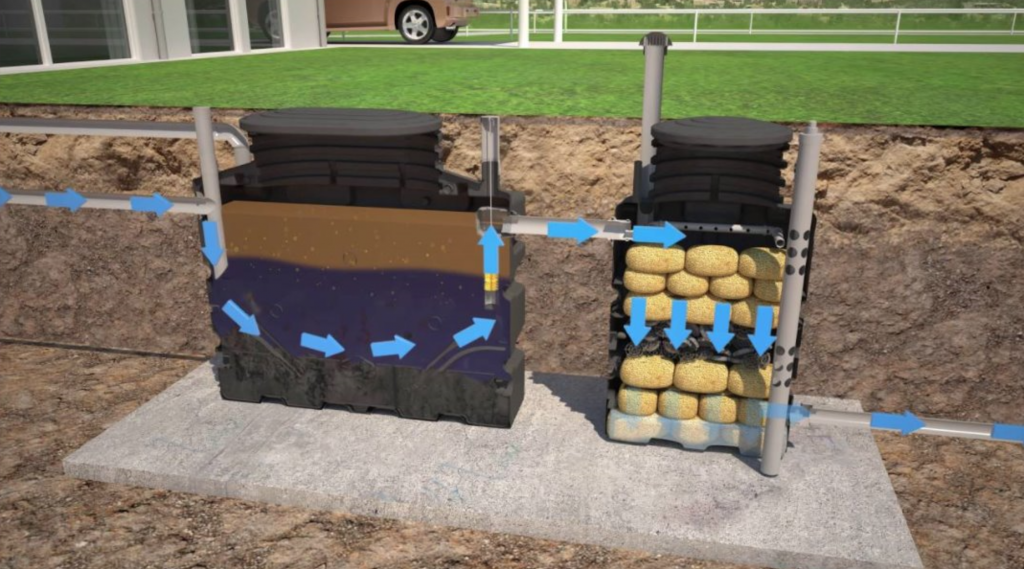
A domestic sewage treatment plant is an underground system that breaks down wastewater from one or multiple homes. It collects and separates waste like a septic tank, but then goes a step further and actually treats the wastewater so it can be safely discharged without causing environmental pollution.
So, how does the sewage treatment plant clean the wastewater? First, it separates the solids and liquids via gravity – the solid sludge settles at the bottom, while the liquid floats on top. The liquid then travels into a separate wastewater treatment chamber of the tank, where it is disinfected by useful bacteria, which grow thanks to compressed air being fed into the chamber via a powered pump.
Eventually, the now-decontaminated wastewater will travel into a final chamber where it waits to be emptied into either a surface water body or a soakaway, while the bacteria move into the sludge chamber. The sludge must be collected by a registered waste carrier, which the person responsible for the sewage treatment tank must arrange.
Think of a domestic sewage treatment plant as a more sophisticated and environmentally friendly septic tank.
What dictates sewage plant sizes for residential properties?
Several factors affect the necessary domestic sewage treatment system size. The two most important are:
- Number of bedrooms – In the context of sewage treatment plants, a property’s total number of bedrooms is used to indicate the minimum population of a property.
- Number of properties – The more properties using a single sewage plant, the larger it will need to be, though some calculation alterations come into play here.
These numbers have a direct impact on the size of the sewage treatment system you’ll need for your property or residential construction project.
Let’s get into the calculations needed to identify the right size for you, as outlined in British Water’s Flows and Loads – 4 guidelines. From here on, we’ll use P (Population, or Population Equivalent) when talking about the number of people in a property.
Single domestic dwellings:
A sewage treatment system must always be sized for a minimum of 5 people, which, in this context, means a 3-bedroom property. Therefore, a 3-bedroom home requires a 5P sewage treatment plant. For each additional bedroom, add 1P. For example:
- 4-bedroom property = 6P sewage treatment plant (5+1P)
- 5-bedroom property = 7P sewage treatment plant (5+2P)
Not everyone uses their home in the same way, and there may be a reason why the above calculations don’t reflect how your residence is or will be used. Get in touch with us to discuss these differences, and we can help advise on the appropriate tank size.
Groups of small 1- to 2-bedroom dwellings:
Some properties, of course, have fewer than 3 bedrooms, such as flats, but this isn’t as commonly seen in the very rural areas where sewage treatment alternatives are typically required. However, these are the calculations that should be applied when a group of these small houses and flats are using the same plant:
- 1-bedroom property: 3P
- 2-bedroom property: 4P
Using these calculations, here are some examples:
- Three 1-bedroom flats = 9P sewage treatment plant (3x3P)
- Three 2-bedroom houses = 12P sewage treatment plant (3x4P)
The reason a few 1-bedroom flats require a larger sewage treatment plant than a 6-bedroom house is that it’s assumed that the occupants of a single house will be sharing the same infrastructure and that the usage will overlap: morning bathroom rush, shared mealtimes requiring just one washing-up session, and so on.
Groups of larger 3+ bedroom dwellings:
For groups of larger homes, you’ll use the single dwellings calculation and add them together. For example:
- One 3-bedroom house and one 4-bedroom house = 11P sewage treatment plant (5P + 5+1P)
If your total P load from any of the above calculations comes to more than 12:
When the population exceeds 12, reductions are put in place to adjust for daily flow fluctuations. When using these calculations, you should always round the number up, not down.
13 – 25 P load
For a group of houses or flats with a population load between 13 and 25, you should multiply the total P value by 0.9. Here is an example of the calculation process:
- 4-bedroom house: 6P (5+1P)
- Four 4-bedroom houses: 24P (4 x 6P)
- 24P x 0.9 = 21.6P
- Round up = 22
- Result: 22P (or equivalent) sewage treatment plant for four 4-bedroom houses
26 – 50 P load
For a group of houses or with a population load between 26 and 50, you should multiply the total P value by 0.8. Here is an example of the calculation process:
- 3-bedroom house: 5P | 4-bedroom house: 6P (5+1P)
- Four 3-bedroom houses and four 4-bedroom houses = 44P (4x5P + 4x6P)
- 44P x 0.8 = 35.2P.
- Round up = 36.
- Result: 36P (or equivalent) sewage treatment plant for four 3-bedroom houses and four 4-bedroom houses.
If you’re not sure any of these calculations apply to your property or properties, get in touch with us, and we’ll talk through your requirements to identify the size of sewage treatment plant or plants you’ll need.
What happens if the sewage treatment plant is too small?
Installing the wrong-sized domestic sewage treatment system can have an array of consequences, from inconvenience to hefty fines. Keep an eye out for the following signs, as they could indicate a sewage treatment system that isn’t big enough to contain the waste it’s responsible for storing:
- Slow draining and blockages – If the drains in the home/s are slow, blocked or gurgling, it could be that your tank is full, indicating it’s too small to hold the necessary waste.
- Bad odour – Sewage smells terrible, so if there’s a leak, you will more than likely be able to smell it.
- Wet ground – A leak will result in water ponding, creating very soggy patches of land.
- Lush plant life – Waste is an excellent fertiliser, so if the lawn, plants, or weeds are looking especially green and luscious, there may be a leak.
If your sewage tank is too small and is leaking into the surrounding ground, this can be classed as environmental pollution. It violates the General Binding Rules set by the Environment Agency in England and Wales, and if you do not address the issue after receiving notice, the agency can enforce action against you.
If you believe your residential sewage treatment plant is too small, give us a call. We can determine if size is the issue before planning the next steps. Replacement is the best course of action, as simply repairing and then emptying the tank more often will be far more costly in the long run.
What happens if the sewage treatment plant is too big?
Many assume that selecting a system that has more capacity than what the property or properties require means there will be no issues. Unfortunately, this isn’t the case. If it’s too big, there won’t be enough wastewater to flow through for the sewage treatment plant to operate properly. This can cause the system to malfunction, resulting in far more maintenance trips than necessary.
Choosing the right sewage treatment plant with Premier Drainage Solutions
Sizing your domestic sewage treatment plant is imperative to avoid leaks, fines, constant repairs, and full replacement. Fortunately, getting it right the first time doesn’t need to be difficult. Use our calculations to determine the right sewage treatment system size you need for your property or land, or give us a call. We can help you choose the right size and type of sewage treatment plant and expertly install it with complete competency.
If you’re based in London, Essex, Norfolk, Suffolk, Cambridgeshire or Kent and require domestic sewage treatment plant advice, recommendations, maintenance, or installation, get in touch today.
Image source: BIOROCK SEWAGE TREATMENT LTD